

As we work to prepare places for optimum learning and living with purpose and meaning, one idea that needs to be added to a prepared environment—consisting of people, ideas, tools, objects and the natural world—is how we help others obtain independence.
Stephen Covey called these steps 7 levels of initiative or self-empowerment.
In Montessori terms we call these steps toward independence, levels of obedience.
In the beginning, whether working with a child or a new employee, we see three levels of growth:
First Level: will | no experience | no skill
Second Level: will | experience | no skill
Third Level: will | experience | skill
(One might ask here—what about the level where there is no will | no experience | no skill? That is an article for another day. Here we are assuming the person we are guiding has a natural willingness to learn.)
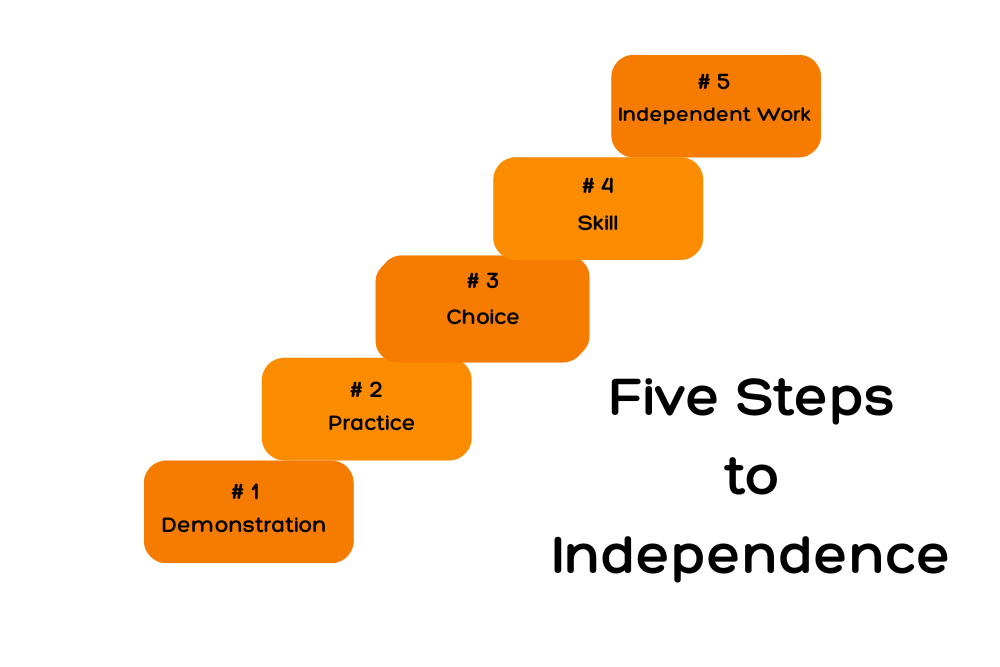
What might add more clarity to the process of helping a person towards independence is combining these three concepts—7 levels of initiative and three levels of obedience–into Five Steps to Independence.
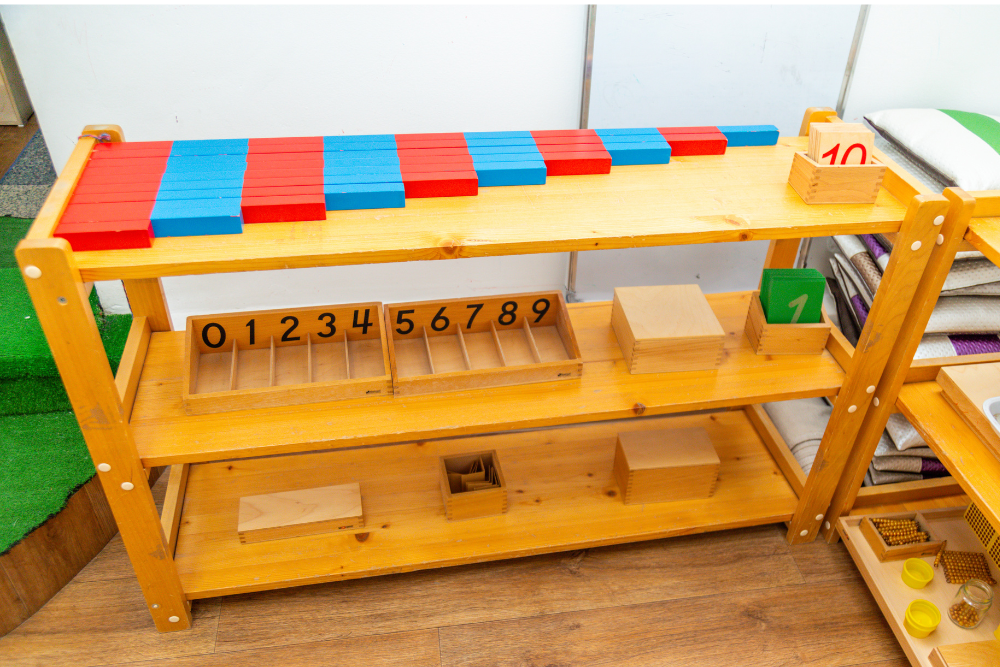
Let’s look now at each of the five steps and what happens in each step, using the Number Rods as an example.
STEP ONE | Demonstrating Activity
Teacher Role | Demonstrates and explains activity.
Student Role | Observes and asks questions.
Example | Teacher demonstrates how to use the Number Rods to individual student.
STEP TWO | Student Practices
Teacher Role | Observe the student practicing the skill: available for questions.
Student Role | Student laying the Number Rods out on a rug.
Example | Teacher observe that the student misses the ordered sequence. On another day invites student to a Number Rod presentation.

STEP THREE | Student Initiates Choice
Teacher Role | Student’s choice of activities bounded by having had presentation.
Student Role | Chooses activities within boundaries of presentation experience.
Example | Student is reminded of the activities they have been shown and chooses an activity.
STEP FOUR | Student Exhibits Skill
Teacher Role | Observes and checks in with student.
Student Role | Works independently within boundaries of experience.
Example | Student lengthens their work cycle with activities they have been presented and practiced.
STEP FIVE | Student Works Independently
Teacher Role | Observes for the next challenge and presents new activities.
Student Role | Explores the limits of the materials and activities presented.
Example | After the student exhibits the ability to lay out the Number Rods in sequence the teacher offers a presentation on “making ten” with the Rods.

An Example
With each presentation, the teacher uses Step 1 to demonstrate and introduce an activity. In the lesson with the Number Rods that initial presentation simply shows the student how to move the ten rods, one by one, from the shelf to a rug, arrange them into an order from shortest to longest. The student uses the Number Rods until they are satisfied, then is shown how to return them in order to the shelf, carrying one rod at a time.
Step 2, the student practicing, may happen on the day of the initial presentation, or perhaps later. With most presentations, in my experience, the student is eager to use the materials right away, but there are also those times where they show no interest.
Once the student starts to use the materials, the teacher observes to see how the student uses the material. Are they able to get them all off the shelf easily? Can the student sequence the rods from shortest to longest? Can they get them back on the shelf in sequence?
In Step 3, the teacher observes that the student is choosing from among the various presentations they have had. The Number Rods are only one of the many demonstrations the student has seen. This Step is a long step, as it may take many weeks or months for a teacher to see the student showing interest and actively learning with their choice of lessons.
The teacher continues to observe for concentration and independent work, reminding the student of all the available activities open to them. As the student makes more and more choices as part of creating their personal work cycle, the teacher continues to give demonstrations in other activities to offer fresh challenges.
During Step 4, the teacher observes the student working independently, choosing activity after activity to create a three-hour work cycle. With these observations, she also sees lengthening concentration.
At Step 5, the teacher sees that the student is working independently and has a strong work cycle. When she observes that a certain level of skill and understanding has occurred, she offers additional challenges with familiar activities.
For each activity, as with the example of the Number Rods, once the student understands the sequence of the Number Rods and the connection to the numerals 1 to 10, additional demonstrations are offered based on the teacher’s observations and following the student’s interests.
The development of independence is a lengthy process that takes many months, and perhaps years, to establish. Each skill learned goes through this same five-step process.
What changes with each step
1. Demonstrating Activity
Students need to see what thoughtful work looks like.
Teachers show:
- how to initiate a task
- how to think through the activity
- how to use materials, and how to return to order
- how to revisit work through friendly reminders
This step builds skills with confidence and clarity, avoiding confusion and timidity.
2. Student Practices
Students begin using the activity materials but still rely on teacher support.
Teachers might:
- remind student of the activity presentation
- observe for misunderstandings (such as not seeing the sequence in the Number Rods)
- demonstrate again when needed
Students practice without the pressure of total independence. Students are free to explore the materials.
3. Student Initiates Choice
Students now start making decisions about their tasks, team, technique and time.
Examples:
- Choose between several activities they have been presented
- Decide where to work in the space
- Select how they will use the activity materials (In Montessori terms we call these variations.)
This initial choice of exercising freedom within limits keeps learning focused while building decision-making skills.
4. Student Exhibits Skill
Students can now manage their learning for meaningful periods of time.
Students:
- plan their work sequence
- gather materials independently
- persist through challenges
- check their own progress
The teacher observes and provides targeted lessons when needed.
5. Student Works Independently
At the highest level, students act as active and independent learners.
They may:
- design daily work cycle
- plan projects
- collaborate with peers
- revise their work based on feedback from peers and others
The teacher becomes a mentor and intellectual partner—a guide–rather than the central driver of activity.
Why the Steps to Independence Matter
Many classrooms try to jump directly to autonomy, allowing too much freedom to students. This can create chaos. Using the Steps to Independence limits a student’s freedom of movement and choice based on the student taking responsibility to choose, practice, and choose again. Also guiding the process is the teacher’s observation of the student’s work.
Without the initial steps, and limitations, students may experience confusion rather than freedom, and may lack courage to initiate a choice of activity.
The steps ensure that autonomy develops alongside:
- competence
- responsibility
- self-management
- intellectual curiosity
- concentration
Students learn how to use freedom well.
A simple way teachers can use the steps
A helpful reflection question is:
“Where is this activity on the five steps to independence?”
If students struggle, move down a step or two to the appropriate level, and add support.
If students succeed easily, teachers can move up the ladder, offering more choice and challenge.
When using these five steps to independence teachers usually observe, over time, student activity naturally shifting toward higher levels of independence and concentration.
In our learning environments of school and work, awareness of these steps to independence help students and employees reach autonomy in a clear and purposeful way. In the process they also develop skills for competence, responsibility, self-management, intellectual curiosity along with focus and concentration.
Join me for a complimentary mini-workshop…
